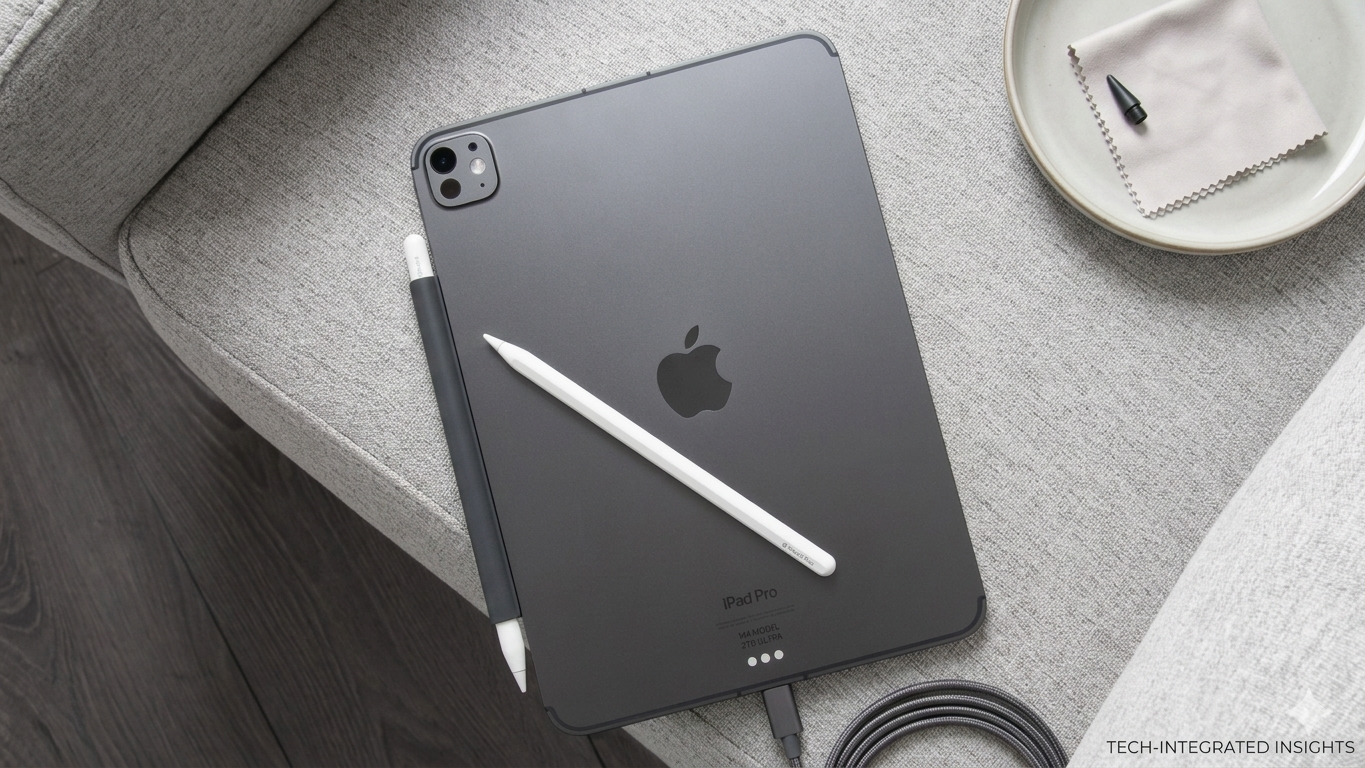
The tablet landscape in 2026 is no longer about just “watching movies” or “checking emails.” These devices have evolved into modular workstations, creative canvases, and AI-powered sidekicks. If you are standing in a tech store today, two names likely dominate your view: the Apple iPad Pro (now featuring the groundbreaking M4 chip) and the Samsung Galaxy Tab S9 series.
Choosing between them in 2026 is a difficult task. One offers the most powerful mobile silicon ever made, while the other provides a versatile, “out-of-the-box” productivity suite that defies traditional tablet limits. In this deep dive, we compare the Apple iPad Pro vs Samsung Galaxy Tab S9 to see which one deserves a spot in your backpack.
1. Design and Display: Tandem OLED vs. Dynamic AMOLED
In 2026, display technology has reached a pinnacle. Both Apple and Samsung have moved away from traditional LCDs in their flagship lines, but they take different paths to visual perfection.
Apple’s Tandem OLED
The 2024–2026 iPad Pro features a “Tandem OLED” display. By stacking two OLED panels, Apple has achieved a staggering 1,600 nits of peak HDR brightness.+1
- The Benefit: This is the brightest, most color-accurate screen for outdoor use and professional color grading.
- Pro tip: If you are a photographer or video editor, the iPad Pro’s “Nano-texture” glass option is a game-changer for reducing glare without losing sharpness.
Samsung’s Dynamic AMOLED 2X
The Galaxy Tab S9 (and its successors like the S10 Ultra often found alongside it) uses the Dynamic AMOLED 2X. While it doesn’t get as blindingly bright as the iPad, it offers deeper blacks and a more cinematic 16:10 aspect ratio.
- The Benefit: Most movies and TV shows are filmed in widescreen. On an iPad (4:3 ratio), you get thick black bars; on the Samsung, the content fills nearly the entire screen.
- Durability: Unlike the iPad, the Galaxy Tab S9 series boasts an IP68 water and dust resistance rating. You can literally use it by the pool or in a dusty workshop without fear.
2. Performance: The M4 Monster vs. Snapdragon Efficiency
When it comes to raw power, the gap between Apple and the rest of the world has widened in 2026.
- Apple iPad Pro (M4): The M4 chip is essentially a laptop processor inside a tablet. It handles 4K video renders, complex 3D modeling in Shapr3D, and AAA gaming with ease. In benchmark tests, it remains nearly 2x faster than most Android competitors.+1
- Samsung Galaxy Tab S9: Powered by the Snapdragon 8 Gen 2 (or Gen 3 in refreshed units), the Samsung is incredibly snappy. For 95% of users—browsing, multitasking, and office work—you won’t notice a speed difference. However, for “Pro” workflows, it simply can’t match the iPad’s thermal efficiency under heavy load.
3. The Stylus Showdown: Apple Pencil Pro vs. S Pen
The “pen” experience is often the deciding factor for students and artists.
The Apple Pencil Pro ($129 extra)
The new Apple Pencil Pro features “Squeeze” gestures and haptic feedback. It feels like a precision tool. However, it is a separate purchase, and the plastic-on-glass feel can be slippery for some.
- Best for: Graphic designers and illustrators who need the most advanced pressure and tilt sensors.
The Samsung S Pen (Included Free)
Samsung includes the S Pen in the box. It features a rubberized tip that provides a “paper-like” friction without needing a special screen protector.
- Best for: Note-takers and students. The S Pen feels more natural for writing long-form notes, and the “Air Gestures” let you control your tablet like a magic wand from across the room.
4. Software and Productivity: iPadOS 26 vs. Samsung DeX
This is where the “personality” of each tablet truly shines.
- iPadOS 26: Apple has finally improved Stage Manager, making window management feel more like a Mac. It is polished, secure, and has the best third-party app library (Procreate, Final Cut Pro, Logic Pro).
- Samsung DeX: Samsung’s killer feature is DeX mode. With one tap, your tablet interface transforms into a Windows-like desktop with a taskbar and overlapping windows.
- Practical Insight: If you want to plug your tablet into a monitor and use it like a desktop PC, Samsung DeX is still years ahead of Apple’s external display implementation.
Comparison Table: At a Glance
| Feature | Apple iPad Pro (M4) | Samsung Galaxy Tab S9 |
| Display Type | Tandem OLED (Ultra Bright) | Dynamic AMOLED 2X (Cinematic) |
| Processor | Apple M4 (Unbeatable Power) | Snapdragon 8 series |
| Stylus | Apple Pencil Pro (Extra Cost) | S Pen (Included Free) |
| Water Resistance | None | IP68 (Waterproof) |
| Storage | 256GB to 2TB | 128GB to 1TB (Expandable) |
| Best For | Professional Creators | Multitaskers & Students |
Conclusion: Key Takeaways
The answer to “Which tablet is better in 2026?” depends entirely on your specific needs:
- Buy the Apple iPad Pro if: You are a professional creative who needs the best apps (Procreate/Final Cut), the fastest processor for rendering, and the brightest screen for outdoor work.
- Buy the Samsung Galaxy Tab S9 if: You want the best value (free stylus!), love watching movies in widescreen, need a waterproof device, or want a tablet that can genuinely double as a desktop computer via DeX.
Ultimately, Apple wins on raw power and apps, while Samsung wins on versatility and value.